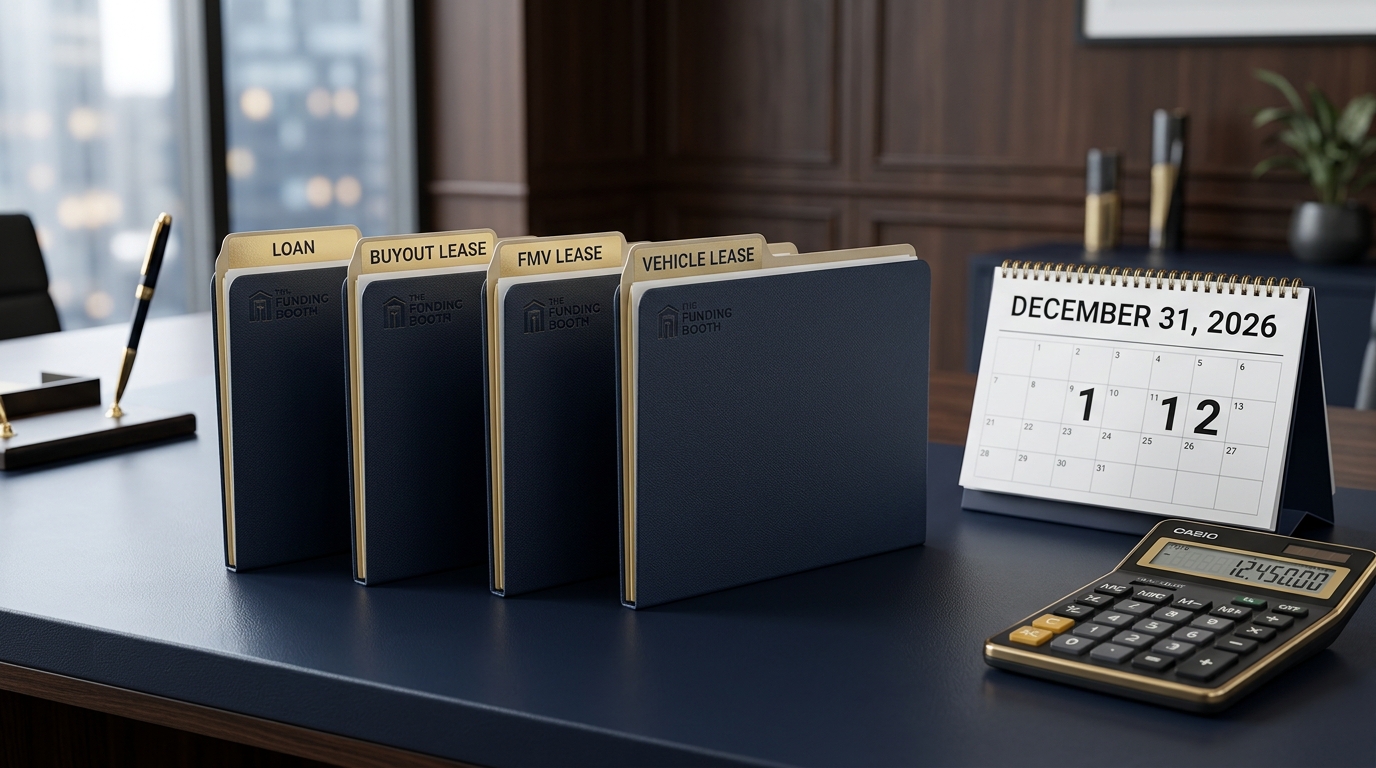
Quick Summary: An equipment finance agreement (EFA) or $1 Buyout can make sense when ownership and a potential year-end deduction are priorities. An FMV lease may offer lower payments and upgrade flexibility, while a TRAC lease is designed for titled vehicles. To pursue current-year tax treatment, equipment generally needs to be placed in service by December 31.
Choosing equipment financing is not simply a question of finding the lowest monthly payment. It is a decision about ownership, cash flow, how long you expect to use the equipment, and how you want to position the business at year-end. The Funding Booth, based in Plainville, Massachusetts and serving businesses nationwide, helps business owners compare these structures in plain English so they can make a more informed choice.
Whether you are buying production equipment, medical technology, construction machinery, software, vehicles, or another essential asset, the right structure should support the way your business operates—not force you into a one-size-fits-all arrangement.
Is an Equipment Loan or EFA the Right Choice When You Want Ownership?
An equipment loan or equipment finance agreement, often called an EFA, is generally built for businesses that expect to own the equipment. You select the asset, finance the purchase over a defined term, and own it once the obligation is satisfied.
In everyday terms, an EFA functions much like a loan used specifically for equipment. Your business is typically treated as the owner for accounting and tax purposes, though your tax advisor should confirm the treatment for your circumstances. This structure can be a practical fit for equipment you expect to keep for years, such as a CNC machine, commercial kitchen equipment, diagnostic equipment, specialized tools, or manufacturing assets.
Ownership can give you more control. You may be able to keep using the equipment after the term ends, sell it, trade it in, or continue operating it without another lease payment. An EFA can also appeal to owners who want the potential to use available depreciation strategies, including Section 179 or bonus depreciation, when appropriate.
The Funding Booth offers EFAs with no prepayment penalties, and early payoff discounts may be available. That can be helpful when cash flow improves and you want the flexibility to pay the balance sooner. Exact terms vary by transaction and qualification, so it is important to review the payoff terms before moving forward.
What Is a $1 Buyout Lease?
A $1 Buyout lease is a lease structure that is economically similar to financing for ownership. At the end of the agreed term, your business has the option to purchase the equipment for $1.
This option is commonly considered when the equipment is expected to retain value and remain useful well beyond the financing term. A $1 Buyout can be a natural fit for durable equipment that is central to your operations and unlikely to be replaced quickly.
The trade-off is straightforward: because the structure is designed around eventual ownership, monthly payments may be higher than an FMV lease on the same equipment and term. Still, some businesses find that the added payment is worthwhile because the end-of-term outcome is clear.
If your priority is to own the asset without a large final purchase amount, a $1 Buyout deserves a close look. To see how ownership-focused options compare with leasing, review The Funding Booth’s guide to loans and leasing.
When Does an FMV Lease Make More Sense?
An FMV, or fair market value, lease is usually designed for businesses that value lower monthly payments and flexibility at the end of the term. Instead of financing the full equipment cost toward ownership, the payments are based in part on the equipment’s expected residual value at lease end.
At the end of an FMV lease, you may typically have options such as returning the equipment, renewing the lease, purchasing it at its then-current fair market value, or upgrading to newer equipment. This can be especially useful for technology, office equipment, certain medical devices, and other assets that may become outdated before they are worn out.
An FMV lease is not automatically “better” because it can offer a lower payment. It works best when the flexibility has real value to your business. If you expect to refresh equipment regularly, want to preserve working capital, or are unsure whether an asset will fit your needs long term, FMV leasing may be worth considering.
How Does a TRAC Lease Work for Titled Vehicles?
A TRAC lease—short for Terminal Rental Adjustment Clause lease—is commonly used for titled commercial vehicles. It is designed around equipment such as trucks, vans, trailers, and other business vehicles where the asset’s residual value at the end of the term matters.
With a TRAC lease, the lease includes a predetermined residual value. At the end of the term, the vehicle may be sold, returned, purchased, or otherwise handled according to the agreement. Depending on the vehicle’s realized value and the contract terms, there can be an adjustment tied to that residual amount.
TRAC leases can offer an effective way to finance fleet additions or replacement vehicles while aligning payments with expected vehicle value. They are specialized agreements, however, so it is important to understand the residual-value provisions and end-of-term responsibilities before signing.
Can a Sale-Leaseback Unlock Cash From Equipment You Already Own?
Sometimes the equipment you need to finance is already on your balance sheet. A sale-leaseback may allow a business to sell eligible equipment to a financing source and then lease it back for continued use.
The goal is not to interrupt operations. Your business continues using the equipment while converting a portion of its value into working capital that may be used for hiring, inventory, expansion, repairs, seasonal needs, or other business priorities.
Sale-leasebacks can be useful when a company has valuable, unencumbered equipment but would rather put some of that equity to work. Eligibility, valuation, documentation, and available terms vary, so a review of the asset and the company’s broader financial picture is essential.
How Do the Main Equipment Financing Structures Compare?
| Structure | Who owns it | Monthly payment level | End-of-term options | Best for |
|---|---|---|---|---|
| Equipment Loan / EFA | Your business generally owns the equipment | Often higher than an FMV lease | Ownership after payoff | Long-term equipment use, ownership goals, and potential depreciation planning |
| $1 Buyout Lease | Your business purchases at term end for $1 | Often higher than an FMV lease | Buy for $1 | Businesses that expect to keep the equipment |
| FMV Lease | Leasing company owns the equipment during the term | Often lower | Return, renew, purchase at FMV, or upgrade | Technology cycles, flexibility, and payment-conscious planning |
| TRAC Lease | Generally structured for leased titled vehicles | Varies based on term and residual value | Residual-based end-of-term handling | Commercial trucks, vans, trailers, and fleet equipment |
| Sale-Leaseback | Ownership transfers to the financing source during the lease | Varies by asset and structure | Depends on the agreement | Unlocking capital from equipment already owned |
Why Does the December 31 Placed-in-Service Date Matter?
Year-end equipment decisions often involve more than signing financing documents. For equipment to generally be considered for the current tax year, it typically must be acquired and placed in service
by December 31. In practical terms, that means it is delivered, installed as needed, and ready and available for business use—not merely ordered or approved.
That timeline can be tighter than it appears. Vendor lead times, shipping, installation, title work, documentation, and holiday schedules can all create delays. If tax planning is part of your reason for acquiring equipment, it helps to start the conversation before the final weeks of the year. For a closer look at the timing issue, read why October can be the real cutoff for year-end equipment planning.
Section 179 and bonus depreciation may allow eligible businesses to accelerate deductions on qualifying equipment, subject to tax rules and your company’s particular facts. The potential benefit can be meaningful, but eligibility, timing, use requirements, and tax treatment can differ. The Funding Booth does not provide tax or legal advice, so speak with your CPA or tax advisor before relying on any tax strategy.
What Can Businesses Expect When Exploring Equipment Financing?
From Plainville to businesses across the country, The Funding Booth has funded more than 1,000 customers and placed more than $100 million since 2018. The company works with requests ranging from $5,000 to $100 million, helping businesses explore options for a wide range of equipment types and transaction sizes.
For qualified, established businesses, application-only approvals may be available up to $500,000. A soft inquiry can be used to check options, which helps you explore potential structures without starting with a hard credit pull. There are no upfront fees to review options, and qualifying $0 down or deferred-payment options may be available.
None of these options is a guarantee of approval, rates, terms, funding, or tax results. Equipment type, time in business, financial profile, vendor documentation, and the overall transaction all matter. The value of the process is being able to compare realistic structures before committing to one.
FAQ
Should I choose an EFA or an FMV lease?
Choose an EFA when ownership and long-term use are central priorities. Consider an FMV lease when lower payments, flexibility, and the option to upgrade or return equipment are more important. Your anticipated holding period is often the deciding factor.
Can I pay off an EFA early?
The Funding Booth offers EFAs with no prepayment penalties, and early payoff discounts may be available. Review your specific agreement for the applicable payoff calculation and terms.
Does an equipment purchase have to be completed by December 31 for a tax deduction?
To generally be considered for the current tax year, equipment must usually be placed in service by December 31. Ordering the equipment alone may not be enough. Confirm timing and eligibility with your tax advisor.
How much equipment financing can I request?
The Funding Booth works with equipment financing requests from $5,000 to $100 million. Qualified established businesses may be eligible for application-only approvals up to $500,000, subject to underwriting and program requirements.
There is no universally right equipment financing structure. The better choice depends on your cash flow, tax situation, and planned holding period, especially as the December 31 placed-in-service deadline approaches. The Funding Booth can help you review the possibilities, whether you need an ownership-focused EFA, a flexible lease, vehicle financing, or a sale-leaseback. Request an instant quote, book a free consultation, or call (888) 551-0215 to discuss your equipment financing options.